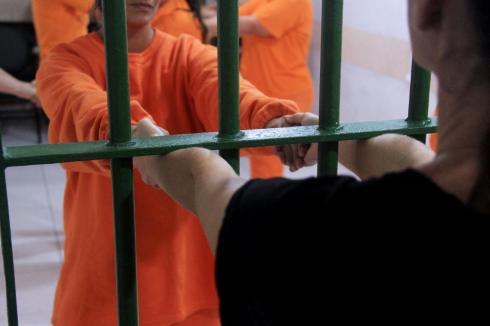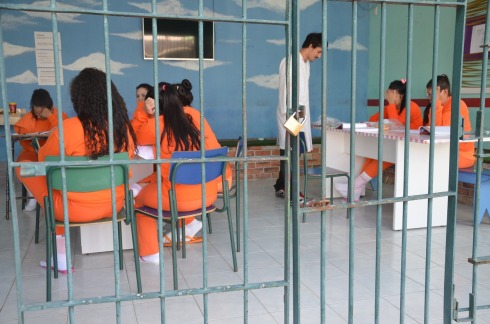
Despite the fact that we number in the millions in the U.S. alone, prisoners’ families do not have very many opportunities to come together to share our experiences. Fortunately, some folks in Durham, North Carolina, have formed an organization to support one another. Read more about it here.
Michigan Review of Prisoner Creative Writing, Vol. 5
7 May

Every year for the last five years students at the University of Michigan’s Prison Creative Arts Project (PCAP) have volunteered to undertake the incredibly unwieldy task of soliciting, receiving, reviewing, and responding to creative writing submissions from hundreds of prisoners throughout the state of Michigan. Every single person who submits writing receives personalized feedback on his or her work; PCAP sends no form rejection letters. The result is a remarkable collection of writing called the Michigan Review of Prisoner Creative Writing, published annually in conjunction with the PCAP Annual Exhibition of Art by Michigan Prisoners. This year’s review is a particularly good one, and I highly recommend it to those of you might be looking for prisoner writing to teach in your courses next year and to those of you who just want something great to read.
To order this year’s review or one from a previous year, use this order form. Each copy of the review is only $15, and all proceeds go directly back into making the next year’s review.
Corrections Corporation of America exploits tax loophole
22 AprThe front page of this morning’s New York Times describes the latest move in the Corrections Corporation of America’s unceasing efforts to find new ways to make money on the backs of prisoners. They have found a giant loophole in U.S. tax law that enables them to avoid all federal taxes by declaring themselves a real estate trust. In practice this means that the folks who engage in the utterly unethical practice of financially investing in keeping a certain segment of our population in captivity now do not have to pay any federal taxes which would fund many of the social programs that help combat mass incarceration.
Jodie Lawston and I have both previously written on this blog about the inextricable links between economics and mass incarceration, and it always boils down to the simple fact that as long as major corporate interests and the government itself have strong financial incentives to lock up lots of people and keep them there for extended periods of time, we cannot reasonably believe that our criminal justice system actually functions to punish or prevent crime. Instead it works to make sure that people who do not have the resources to defend themselves will continue to be disproportionately incarcerated and used as a cheap–or in the case of Texas prisoners, free–labor source.
The Corrections Corporation of America (CCA) is not a real estate trust, and our government should not enable it to escape taxation. In actual fact the CCA has been entrusted with the lives of human beings who live under conditions that no outside party can effectively regulate. This means that the health and well being of thousands of people are subordinated to the corporation’s main objective, which is, of course, to make money.
Robert Avila Granted Stay of Execution
3 AprThose of you who keep up with this blog may remember an earlier post about Iris Morgenstern and her former student Robert Avila, who now lives on death row in Texas. Iris and a team of lawyers have continued to lobby for Robert’s life, and yesterday, within a week of his execution date, they received good news. Judge Ana Perez granted Robert a ninety-day stay of execution, putting his new execution date in July 2013.
Robert received an earlier stay in December. He was then scheduled to be killed on the feast day of the Virgen de Guadalupe–a significant date in the religious calendar for many people in Robert’s hometown of El Paso, Texas. The criminal justice ministry group at St. Patrick’s Cathedral, Robert’s family, and other supporters successfully campaigned to have his execution date moved, which is how he received an execution date of April 10, 2013.
For more information, see the El Paso Times‘ coverage of this latest development in Robert’s case.
Iris and Robert’s lawyers are very hopeful that new evidence will grant him a new trial. Robert, Iris, and I are all very grateful to those of you who wrote letters to Robert in response to my earlier blog post. People in prison, especially those on death row, need to know that they are not forgotten and that their lives have value, and those letters helped Robert through a terrible time. Mil gracias. Robert’s battle for his life is not over, but this is a significant victory for him and for those of us who oppose the death penalty.
Good Friday, Medical Care in Prison, & the Anniversary of Pepper Ramirez’s Death
29 MarThe following post was originally delivered as a reflection on Good Friday as part of a service at St. Titus Episcopal Church in Durham, North Carolina, in 2011. My husband and I had been asked to write reflections based on Bible verses connected to Good Friday, and this was mine. A dear friend of my father’s died in prison shortly before Good Friday the year that I wrote this, and I post this here today to honor his memory and to remark upon the sad state of medical care in Texas prisons, which only appears to have gotten worse since I wrote this. –Ashley Lucas
Father, forgive them, for they know not what they do.
Luke 23:34
We tend to think of forgiveness as something personal—a thing we ask of those whom we have wronged directly: the person whose car we rear-ended, the loved one to whom we spoke in anger, the acquaintance about whom we thought unkind things. This sort of forgiveness gets us through each day by helping to mend our relationships with those around us, repairing and strengthening our ties to those with whom we interact each day. Without it we would be in shambles, but God’s forgiveness is much larger than we can imagine.
When Jesus said, Father, forgive them, for they know not what they do. He was not addressing his executioners, who had just nailed him to the cross. He was speaking to God, his Father, asking a parent to forgive not just those who were there that terrible day at Calvary. Jesus asked God to forgive each of us throughout the millennia that would follow his death because he knew we would continue to harm one another and that we would need to be forgiven for an enormity of offenses.
As the child of a prisoner and a scholar who studies incarceration, I think often about the fact that Jesus was a prisoner executed by a government with the approval—indeed the zealous insistence—of the populous. We in North Carolina are subject to both state and federal governments which execute those around us, and the majority of our fellow citizens are in favor of this practice, though few of us know much about life on death row or the individuals who are being killed. However we personally feel about the death penalty, the fact that it is part of our culture and our system of government is well-known and at times hotly debated. We know that this is a thing we do, even if we don’t fully understand it.
I awoke this morning wanting to speak about offenses that we almost never realize we have committed. Just before last night’s Maundy Thursday service, I learned that my father’s best friend had died. My father has been held captive in Texas prisons since 1994, and over the years he has grown close to a fellow prisoner named Pepper Ramirez. I never got to meet Pepper, and all I know of him is what my father has told me in letters and in visits. From what I understand, Pepper ended up in prison because he killed a man who was harming his sister. Though I do not know the length of his sentence, I am sure he served well over a decade, perhaps two. Pepper was a good friend to my father, told funny stories, and made big plans for what he would do when he got out of prison. He had a large and loving family who desperately wanted him home and who remained steadfast throughout the many years of his incarceration.
In the last few years, my father’s news about Pepper always had to do with his health. Pepper suffered from severe glaucoma which required medical treatment. Medical care in Texas prisons is a terrifying thing. In order for a prisoner who is held in a rural area to receive treatment, he or she must be handcuffed, shackled, and chained around the waist to another prisoner. These patients are then loaded onto a bus and driven to another prison where they may spend a week waiting to be transported to the medical prison. For men on my father’s unit, the Robertson Unit where the men wait before they are taken to the medical unit is one of the most violent prisons in the state. Several years ago when my father’s friend Pepper was on his way back from the medical unit where he had been treated for his glaucoma, he was held at Robertson for several days. The violence surrounding him at Robertson was so stressful that he had a heart attack and was taken back to the medical unit for open heart surgery. Pepper never received even one doctor’s visit for follow up treatment after his open heart surgery. He would not risk enduring the trip back to the medical prison. My father tells me that many men would rather die from their ailments than have to take that trip. It is widely believed by both prisoners and staff that the process of receiving medical care in Texas prisons is deliberately constructed to discourage the ill from seeking treatment. It costs the state less to let the elderly and infirm die of their own accord.
Earlier this week my father’s prison was undergoing a shake down. Pepper has been very frail in the years since his heart surgery, and he collapsed after carrying his possessions either to or from the gym. I do not know if an emergency response team could have saved his life, but there was not one on hand. The only doctor on staff is the elderly country doctor who delivered most of the guards who work in that prison, and even he is not on duty every day. Pepper Ramirez died this week on a cement floor far from his family, and I feel responsible for his passing.
We live in a country where we think we know what justice is, where we are told that get-tough-on-crime legislation makes us safer, where we are encouraged not to think of prisoners as people but as beings not like us who have forfeited their civil and human rights by being irredeemably bad. The jury that convicted Pepper Ramirez likely did not know that he would not be given adequate health care. They may not have considered what his family would endure year after year as they watched him deteriorate. Even if they had thought about these things, they may have felt that he, and perhaps also his family, deserved what they were getting. I am not a witness to Pepper’s crime, but I am a secondary witness to his character and his suffering. He was a good friend to my father, and for this I will be forever grateful. Please pray today for Pepper’s family. Pray for my father and the other men who lost a friend and who saw too well the fate that might await each of them. Pray for all of us that we might not forget the lives and struggles of those who are deliberately hidden from us. Pray that we find ways to end violence, addiction, and suffering through compassion, treatment, and forgiveness. Pray for guidance to stop cycles of institutional violence. Pray that we may learn not to be passive bystanders to the suffering of others.
Father, forgive us, for we know not what we do.
Solitary Confinement for Children in Prison
27 MarRock Center with Brian Williams recently aired a story about the terrible things that minors–some as young as nine years old–endure in solitary confinement in United States prisons. Watch a clip of this story aired on the Today Show here.
If criminal justice administrators routinely agree that minors are so much at risk in adult prisons that they must be kept in solitary confinement to protect them, shouldn’t we rethink our decisions to send children to prison?
Pope Francis to Wash the Feet of Prisoners
26 MarThe new pope has sworn to dedicate much of his papacy to serving the poor–an admirable goal and one which will be very difficult to uphold in the long run as the demands of administration at the Vatican settle in. However, Pope Francis is off to an auspicious start. When he emerged on the Vatican balcony in his first appearance as pope and asked the people to bless him, he displayed a level of humility seldom seen in a world leader. What’s more, he appears genuine in his efforts to live in close contact with the poor and to serve them directly. He never lived in the auspicious residence reserved for the bishop of Argentina, and on Thursday, March 28, 2013, he will wash the feet of twelve prisoners in Rome, as Jesus washed his disciple’s feet the night before his crucifixion.
For Christians, the act of washing another person’s feet engenders a mix of humility and honor. The person washing the feet humbles herself in cleansing what in Jesus’ day would have been the dirtiest part of a person’s body–rough and covered in the day’s dust. The person who allows her feet to be washed is simultaneously honored by the act of another person’s service but also humbled in having another person care for her in this intimate way.
Regardless of our systems of belief, we could all learn from what the pope will do this Thursday. This act is a public reminder that we should remember those whom we have shut away from our sight. We should honor them with human dignity, concern, and care, as we should all people. We should not be afraid to lay compassionate hands on those whom we have been taught to fear.
Thank you, Pope Francis, for remembering the incarcerated. May this act inspire people around the world to treat prisoners with kindness.